The Chiemgauer
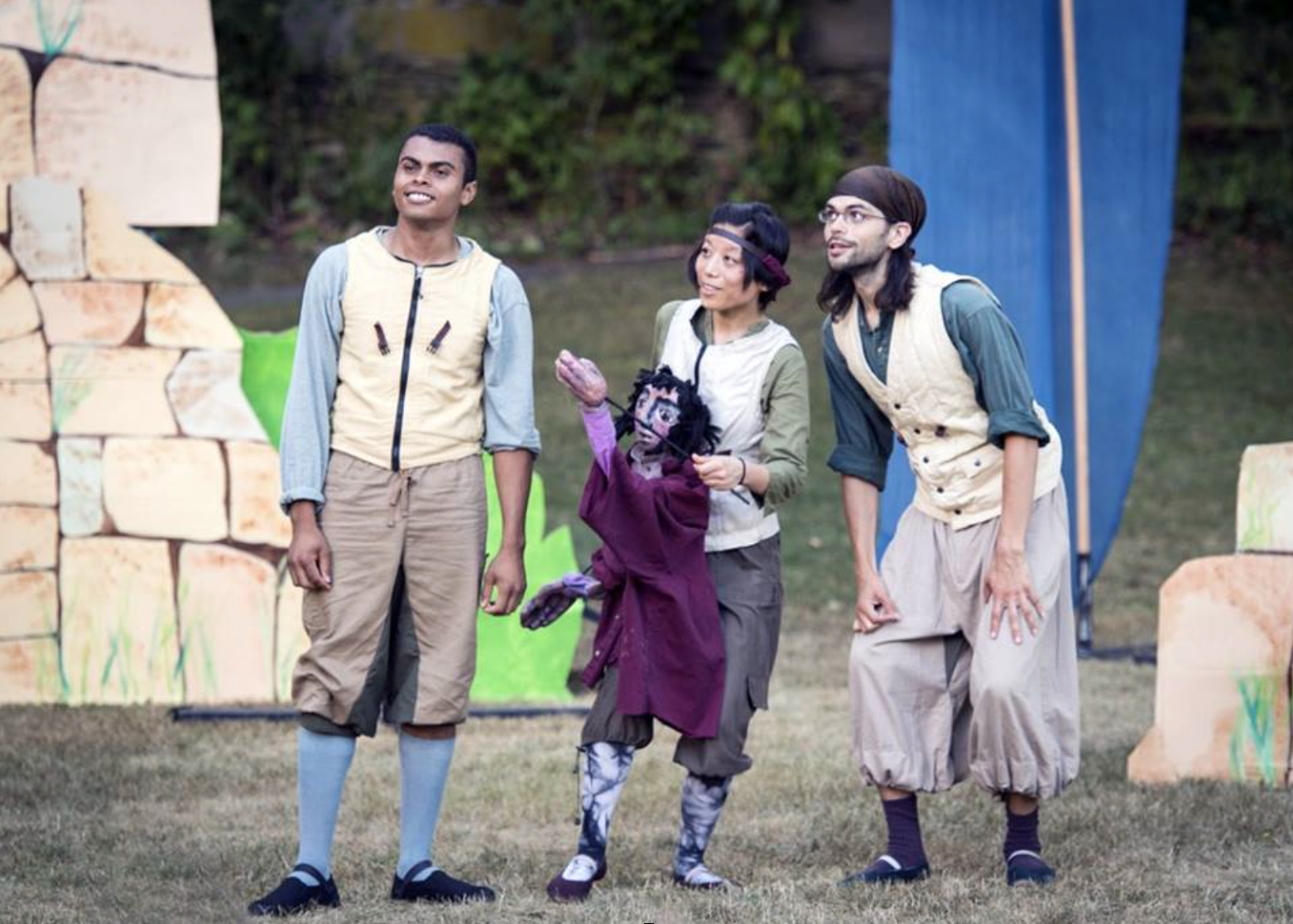
After visiting Chiemgau in 2015 I was inspired to produce Michael Ende's famous children's story Momo. This is a photo from a performance on the village green in Philmont, NY, part of a tour during the summer of 2016. From left to right are Michael Balin, Nao Kobayashi, and Gabriel Rodriguez. Nao is playing Momo.
In the summer of 2015, I had the opportunity to visit the Chiemgau region in Southeast Germany that is home to the “Chiemgauer” currency project I had come across in The Guardian in 2011. Traveling to Salzburg and then westward toward Rosenheim, I enjoyed the landscapes and little village scenes opening outside the train window. Arriving in the village of Traunstein, I walked into a local bank to see about "purchasing" some Chiemgauer (exchanging it for Euros). The teller was well informed and happy to lead me through the details, offering me a small booklet that listed all the businesses that accepted the currency, and the not-for-profits that benefited from its use.
I left the bank and set out to find the office where I was to meet some of the currency project’s board members. Eventually I came to a little park, passed a café on the street, and entered a building that led up to a second floor office space, containing two desks and a wooden coffee table. They were expecting me and greeted me with a warm welcome (and perhaps a bit of the thrill elicited when I tell people I am from a glamorous place called New York, though in my case this is rural Upstate New York, a land of rolling countryside far removed from the commonly held images of Times Square and city lights). I met with Peter Fochler, Christophe Levannier, and Elke Mathe, all intensively involved in the initiative. What a treat to hear in detail the ideals and successes of the project, and also future plans. One ongoing project was related to a film about Michael Ende and his famous book “Momo.” It was the dynamic forces of economic and cultural life that had inspired Ende to write the book, and indeed an illustration of Momo graces the Chiemgauer note. The Chiemgauer takes its name from the region that is its habitat. Indeed the Chiemgauer behaves more like a living/dying creature in a habitat than like a mere object of utility. No sooner is it “born” upon issuance, than it begins to depreciate at 8% annually, and expires (or dies) after two years in circulation. Moreover it has distinct life processes: when purchased, immediately 3% of the total purchased amount is directed toward a local not-for-profit of the buyer’s choice. One Chiemgaur is equivalent to one euro, so for every $100 Chiemgauer purchased 3 euros goes toward these community initiatives.
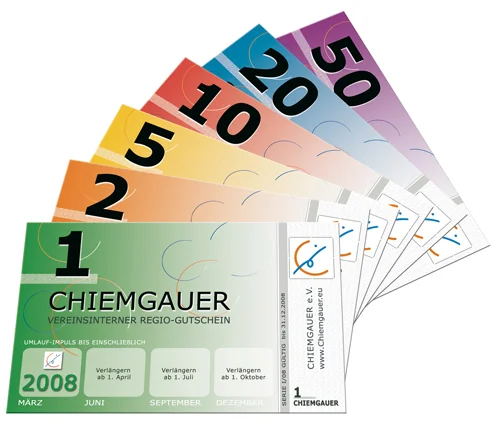
The initiators of the novel Chiemgauer “creature” are none other than a group of tenth graders and their economics teacher, Christian Gelleri. They designed the currency as a fundraising project for a Waldorf school, but predicted more far-reaching benefits. By adding a depreciation rate they were convinced that commercial relationships would increase at the local level, with the benefit of increased local solidarity and connectedness, and a reduction in the CO2 emissions and other waste resulting from transportation.
After leaving the invigorating conversation and warm hospitality of Peter, Christophe, and Elke (which included copious food and coffee), I met Christian Gelleri at a café near the train station. A tall slender man about 40 years old, he arrived on a bicycle and proceeded to further warm my heart with his enthusiasm and knowledge. He told me about the origins of the project in his tenth grade economics classes and about the repeated visits of Bernard Lietaer. Traveling through many areas of political theory, we discussed decaying money, the economic thought of Sylvio Gessel and Rudolf Steiner, and the movement for the threefold social order, famously championed by Rudolf Steiner and later Joseph Beuys. These ideas, especially the latter, directly inspired Gelleri and his students in creating the design that they did.
One result of this design is that the Chiemgauer circulates around 2.5 x faster than the euro. Upon receiving a bill one uses it more quickly. While our habitual way of thinking might suggest this is good because it means more business, there are more interesting and subtle facets of this fact. Consider for instance that in making money into another perishable good, it loses some of its aura as a super commodity. It rusts like iron, it molds like bread.
This may raise the concern that increasing trade will simply increase excessive consumerism; yet another potential exists in the increased velocity accompanying the decaying Chimgauer: it educates its user to remain conscious of the perishable nature of economic life. Thus it has the potential to foster a more ecological and sustainable awareness that acknowledges the finitude and perishability of our lives in so far as we produce and consume. Accompanied by the right inner orientation this weakening of the storage function of money liberates one to look for investments that last. Investing in common spaces, public art works, culture and education all appear in a more clear and definite light, as the true sources of wealth and the true capital of a community.
“Money and capital cannot be an economic value, capital is human dignity and creativity. And so, in keeping with this, we need to develop a concept of money that allows creativity, or art, so to speak, to be capital. Art is capital." — Joseph Beuys, What is Art?