Can everything be art?
BY NATHANIEL WILLIAMS
Growing up at the end of the 20th century I remember taking art classes and hearing that everything could be art. As a teenager I was inspired by this notion, as were many people my age, that all of life could be infused with a feeling of meaning and inspiration. “Everything can be Art,” like any slogan, is only as wise as the context in which it appears. And most of the contexts in which I have encountered this slogan have revealed its mind-numbing power, which amounts to the feeling: “If everything is art, then there is no discerning it.”
One of the most famous artists of the last century to work with this thought was Jospeh Beuys. With Beuys I have come to respect a deeper perspective in this attitude, one that grasps the creative dimension of all production, from art to the collaborative production of the global economy. When we think about art, typically, we think about culture, about creativity, intelligence and skill. After World War II Beuys was convinced that the life of intrinsically motivated productivity had to once again be sensed all the way down into the economic productive areas of society, and that delicate notions of art that focused on art objects, museums, galleries, and artifacts could offer no redemptive power to the crises of modern society.
Before we go into this in any detail we can bring to mind some experiences of intrinsically driven, creative freedom.
Some years ago I was hired to teach stone sculpture to a group of seniors at a school in the Pioneer Valley in Massachusetts. The class was outdoors at the foot of the Holyoke mountain range. The mountains make their run from east to west, which is unusual, and have a fluidity to their appearance on the horizon. It was one of the most beautiful workshop settings I’ve ever had. Each student chose from a pile of rough marble blocks. After cutting swaths of linen and sewing our own sand bags to use for propping the stones, we created tripods from saplings. We set the stones on the tripods and went to work with point chisels. The task was to develop the natural shape of the stone into a non-representational sculpture. Each student was to draw an emergent composition of interrelated concave and convex areas out of the rough rock. Working under these mountains, staring at the various stones of the student’s and seeing the potential in each, had a strong effect on me. I commuted to the school each week from the Hudson Valley in New York. One afternoon fresh from class on my westward drive, powerful images and lines of poetry started to come to me. They were carried by a vital urgency, like a pulse of life. The rest of my day and plans receded before this strange vital joy. I parked on the shoulder of the highway.
“The sun reaches down with its warm arms and fluffs lake water into clouds.”
This is all I got. I pulled back on the road. Within minutes more lines and images were pressing in on me. I pulled over again. This repeated itself and in the end there was a poem.
The sun reaches down with its warm arms
And fluffs lake water into clouds
With which it pads the sky
That our hard skulls wander through.
It planted two sun seeds on that rock
Which blossomed into eyes,
Like mouths of a cave,
And the moon looked inside.
Then the sun took its bow and
Stretched it broad with shafts between
Letting them fly through the cave eyes.
They punctured the soul’s dark walls
And continued to the center of the earth ball.
From these holes in the dark ground of the soul
Delicate light, like stars in a desert sky, shone,
And they grew, turning inside out
To become half diamonds, half morning dew.
The sun reaches down with its warm arms
And fluffs water into clouds
With which it pads the sky
That our skulls wander through
Skulls with eyes, eyes shining dew drops and starry skies.
It is an odd poem. I am unsure of its merits. But the experience of its emergence will be familiar to many artists. Years later I read an interview with Tom Waits. He related how he was driving down an eight-lane highway in LA when a song approached. Frustrated at the capricious nature of the muse he turned to the sky and shouted: “Excuse me. Can you not see that I'm driving? If you're serious about wanting to exist then I spend eight hours a day in the studio. You're welcome to come and visit me when I'm sitting at my piano. Otherwise, leave me alone and go bother Leonard Cohen.”
This type of experience, where a creator senses they are in the presence of an inspiration that appears with its own life and spontaneity, its own urgency and reality, is also one of the reasons that an artist can remain intrigued by the work of art. It is, of course, not always so clear, and sometimes is dully sensed below an intense process of drafts and revisions. But there is a basic feeling that there is a life that has a relative independence. And it is connected to a feeling that creations are also visitations, or explorations, of a field of experience that does not totally coincide with day-to-day logic or planning. These are visitations of the future world, and one participates in bringing it into the present.
One group of researchers from Harvard Business School studied the qualities of such inspired works of art. They enlisted 23 professional artists, asking them to randomly select 10 commissioned works and 10 non-commissioned works. Art is not always created out of the inspiration of the artist; it can also be created by dictate. One can say, we need art, let there be art. One can pay an artist and tell them what one desires. The researchers wanted to see if there was a difference between works that were the result of extrinsic motivation (some outer reward or punishment) or intrinsic motivation (inner enthusiasm and inspiration). All the works were then blind-judged by a panel of artists and curators, in the two categories of creativity and technical skill. The panel found no difference between the two groupings of the art when it came to technical skill but found that the non-commissioned works were significantly more creative.
Freedom, acting out of the singular law of inspiration, shows in the the work itself. One’s ability to be creative appears to be connected in some way to the freedom one is granted while creating. The quality of living, inspired culture seems to be connected to the idiosyncratic emergence of art. Liberty and living culture seem connected.
Perhaps it is also this love that the creator directs toward their work, a kind of loyalty, that gives those dedicated to the intrinsic life of creativity better chances at making it into a vocation. There was a long term study on intrinsic motivation where art students in Chicago where asked about their motivations for developing themselves in art school. Decades later there was follow up, to see if they had continued to pursue art. Artists who were intrinsically motivated were more able to integrate into the profession while those who were clearly extrinsically motivated often moved to other types of work. The permanence of creativity, over lifetimes, and its integration into society, appear tightly tied to one’s inner life being connected to one’s outer vocation.
In the most radical experiences of creativity we can characterize experiences where a person is regularly assailed by inspirations, whose end they can hardly explain, and which they want to follow out of an intrinsic interest and inner need. It can be sensed as a kind of evolutionary force, that wants to be made real and at the same time, even while in process, radiates reality over life and makes it worthwhile. I have focused on art, a type of creativity where the ultimate use and purpose of the creation is highly questionable, but the creative experience will be familiar to people working in any number of areas — as mathematicians, engineers, researchers, lawyers, or journalists.
In relation to creativity it is possible to characterize money in the following way: Money is simply a condition that allows one to be creative—to participate in the emergent future.
Obviously, one’s needs must be met so that one can create. Money gives us a claim on goods and services in the market. One can use money to pay rent and utilities, to buy food, to get materials and tools. In this way, money allows one to be creative. We can say people work for money but really it’s not true in many cases. Money is the example par excellence of extrinsic motivation, but with intrinsic motivation, one’s center of being is in the act, not the pay that might be connected to it.
Money can be felt as the freedom to be creative. We can think about how this differs from the feeling we have of money as a means to intensify consumption. As strange as this may seem in a society that seems to prize individualism over all else, it’s not hard to sense that our feeling for money as the means to fuel our consumption has taken the place of the feeling of money as the means to free our creative expression, our individual inspiration. And so our rapacious consumerism is directly connected to our deficit in living culture.
Once again, for the intrinsically motivated creator, money is sensed as a right to shape the future through freedom.
In the economy and in the very life and structure of corporations, the most obvious way culture shows up is as research and development. Here, again, I am connecting culture to individuation and intrinsic motivation of individuals. Some managers have consciously worked against over-planning and control in the workplace, as an open door to new life and insight. They have made moments of de-centralized production. In the 1950s, the president and chairman of 3M, William McKnight, included 15% time in the regular work week when workers were to put work aside to doodle and daydream. Post-it notes were born from such “experimental doodling.” More recently, Google has become well-known for encouraging developers to use as much as 20% of the workweek for projects of their choice, with no justifications, no businesses plans, and no vetting of ideas. As we saw with art, in the research and development wing of some corporations the future is being created.
This transition from individual inspiration to creative departments in corporations is not the greatest leap. Yet when we go one step further we find that even outside of these creative departments, while in a very different way, all work is future oriented.
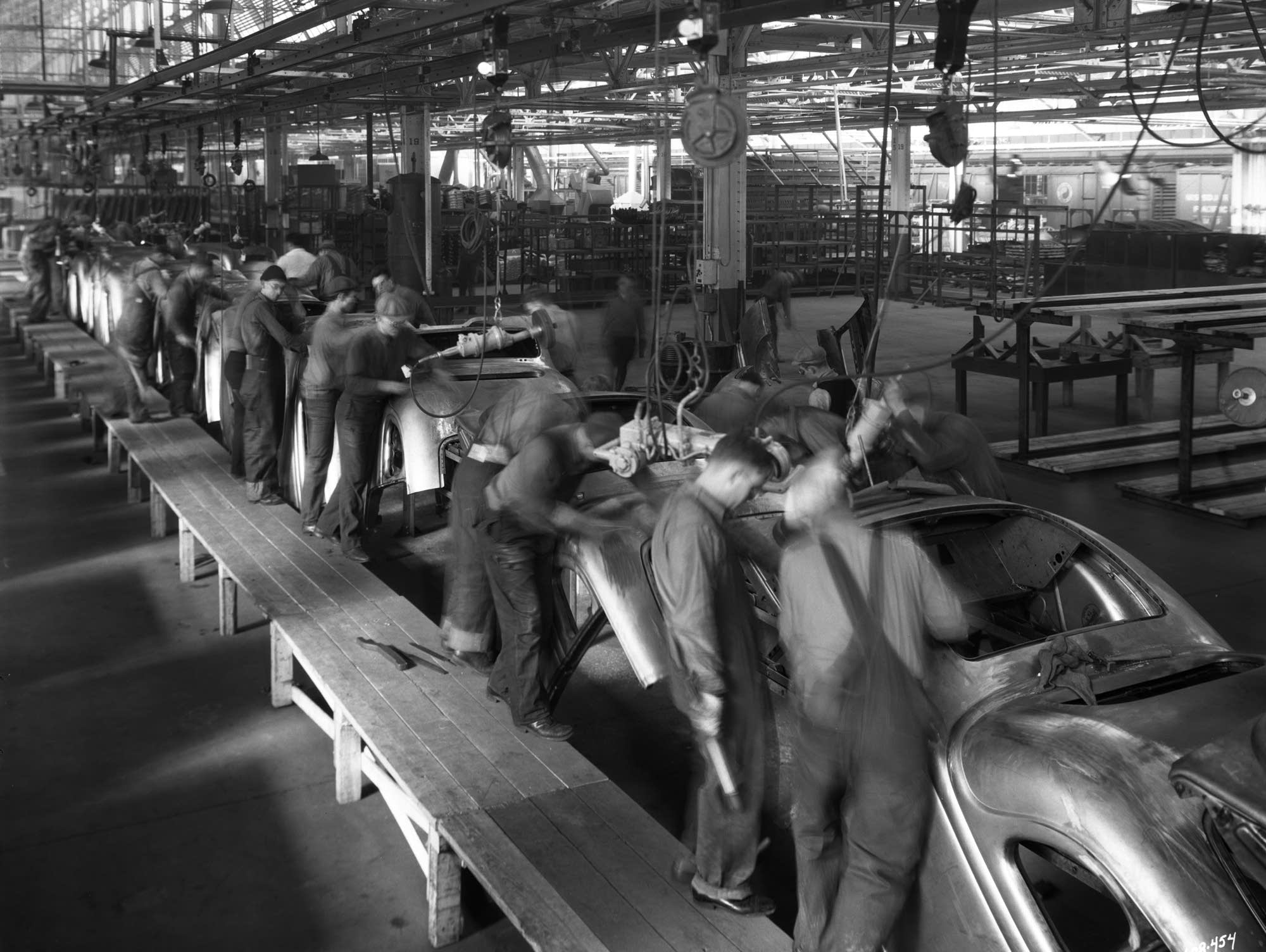
But what about areas of society that demonstrate the least amount of freedom? The way we organize the economy, through the division of labor and specialization, has led to extremely limited fields of action for countless people. One early genius in understanding the efficiency and productivity that intense cooperation holds was Henry Ford. He was one of the first industrialists to introduce the assembly line. The time it took to assemble a Model T dropped from 12 hours to 2.5 hours and made it possible to lower the prices on the cars and double wages for workers on the assembly line. It also transformed the experience of work and production. The experience of those working together to produce material goods became almost unbearable. Workers required less skill, and had less understanding and connection to their tasks. In Marx’s powerful image people are reduced to appendages of the machine. Creativity and individuation are severely limited and the connection between the producer and any intrinsic meaning in their activity dries up. Because of the limited and relatively simple nature of the task in an assembly line, one need not even understand the overall project one is working on. One hundred years after Ford’s assembly line—a time of rapidly increasing specialization and intensification within the global economy—many people work without having a concrete understanding of their contribution to the future. Here, where the process of cooperation, collaboration, and specialization have been driven to an extreme, the intrinsic creative experience of production is most obscured. These basic observations led Marx to his notions of alienation, both from the fruits of our labor and from each other.
What does one work for then? Here we can see how one could come to work for money. The act of production becomes so void of meaning that only the monetary incentive remains. The stultifying effect of intense, extrinsically motivated production has the power to atrophy the very fount of creative motivation. One comes to understands one’s labor as a commodity. There is a market on which one can sell one’s creativity. What does one work for? The pay. What is the pay for? Food, shelter, healthcare, and clothing. The old labor chant captures this culture of work: “We go to work, to get the cash, to buy the food, to get the strength, to go to work, to get the cash….” While the productivity that has been made possible is stunning, the work itself is experienced as soul-killing drudgery that does not fill the worker with any meaning. The meaning of life is shifted toward getting paid in order to fulfill responsibilities: paying bills, providing for one’s family, surviving. (I once talked to a teenager about this who likened it to a very bad cyclical video game.) Or you might not be poor, you could be well-off. Then you purchase more goods and have a more luxurious life style. Here, alienation casts a shadow over one's "leisure" time as well, replacing creative activity and social connections with consumerism. These extremes of work culture appear to have lost all nuances of freedom and realizing one’s creativity. One is not inspired nor does one sense one is fulfilling a larger good by serving some need in the world. One’s aspirations can easily become tilted toward more and more private, personal well-being.
Not all businesses are satisfied with this. In an Egyptian corporation called Sekem, the workers gather together in a circle before work and each says their name and how they are contributing to the creative production of the collaborative enterprise. This allows the common project to be grasped by each person, each contributor. Thus, the intrinsic good of the enterprise is able to remain in the consciousness of the workers. The work itself is a good, not only their pay. Under these circumstances, when workers receive money they can understand it as a means to meet their own needs so they can continue collaborating with others in meaningful work. But here something very interesting arises. The intrinsic motivation is now connected not to intense processes of individuation but to intense cooperative processes and interdependence. Intrinsically motivated work in this area has the quality of team work, solidarity, and mutuality. Serving a need through working together with others can touch the deepest chords of our humanity. In Small is Beautiful, E. F. Schumacher has pointed out in discussing right livelihood, that even if work is not required from a material perspective, ignoring the moral, social dimension of work is perilous. Rudolf Steiner suggested in his study of economics that the emergent virtue in the modern economy was fraternity, while in culture it was liberty, which is certainly illuminating from the perspective we have taken here.
Now let us return to our earlier perspective, that money is a right to participate in the creation of the future. Here in this Egyptian corporation, which is large and specialized, money can still be interpreted as the right to be part of creating the future. One receives pay so that one can return and do good work. (In food production, it is quite literally creating the future through meeting the immediate needs of others in the coming weeks). This view of work in the modern economy has a quality that touches the core of creativity, if in a different degree than the examples I opened this consideration with. While I am not suggesting that it is in anyway exhaustive to understand money an opportunity in creating the future, it does seem to me to be typical of a cultural perspective on money and work.
While one can say that all money can be interpreted as a potential to be creative, there is a spectrum of permanence and influence that runs from the production and daily consumption of commodities to the life of culture. On the side of culture the intensity of future creation is high, on the side of commodity production it is lower. On one side, that of social and cultural work, the future bearing power of investment grows as the “return” becomes more obscure, on the other side, that of commodity production, short-term gains skyrocket and long-term transformative power wanes. In the production of commodities and perishable goods, one creates a future where needs are met in the immediate: i.e. a person is fed, and production repeats itself in a predictable fashion. When working in research and development one creates a future that is perhaps five or twenty years out, and novelty is central. A work of art, unlike other physical objects, can last generations, a gateway for countless people to experience aspects of the good, beautiful, and meaningful. Works of art are the experiential essence of singularity—of an object that carries the totality of its significance within itself from age to age. In Arendt’s greatest work she reflects, “Because of their outstanding permanence, works of art are the most intensely worldly of all tangible things; their durability is almost untouched by the corroding effect of natural process, since they are not subject to the use of living creatures, a use which, indeed, far from actualizing their own inherent purpose — as the purpose of the chair is actualized when it is sat upon — can only destroy them.” This aspect of creating the future has effects that are active in ways that a loaf of bread cannot be. Yet all are acts of creating a meaningful future.
Directing resources towards social and cultural work reaches the furthest into the future. It is the greatest fulcrum for transformation. More specifically, the greatest fulcrum for transformation is arguably education, attending to the innate abilities and gifts of the growing generation. Moreover, given the character of creativity one can see how desirable it would be to have schools that do not educate children to be employees for existing enterprises, or citizens with definite political allegiances, but instead help foster the intrinsic interests and abilities of the maturing generation. From an economic perspective the return on this kind of education is immense. It is actually easy to understand the goal of supporting schools and cultural initiatives for their own sakes. We may not sense what exactly the economic return will be, but we can understand that this is to be expected if we believe in freedom and its positive power. The children belong to a world that we cannot picture as it does not yet exist. We can, however, foster their innate abilities and the spirit of freedom in them so that they can create it.
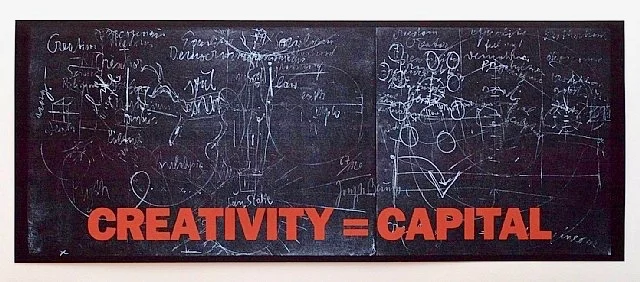
Perhaps now it is time to get back to the point. Not far from where I live there are works from Joseph Beuys on display. One piece is like a ruin at a building site. All told it is not really present. They are the remains of events he called social sculptures. In one of his early works he packed lard in the corner of a cardboard box and engaged passersby in conversation. They might call out; “Beuys, this is bullshit,” to which he would reply, “What do you think then if it is bullshit?” and he would follow his critics around trying to continue the exchange. He saw his greatest achievement in his revisioning art to include all of life, a vision he captured with the slogan “Everyone is an artist!” and the more esoteric formula “art = capital” or “creativity = capital.” This was also the unique tone he brought into the founding of the green party.
In an age of cynicism it is easy to see Beuys as a charismatic snake oil salesman and a charlatan, but if there is any merit to this I do not think it is in his understanding of the relationship between art and capital. He saw a devastating challenge in the fact that our economic life is estranged from our sense of agency, creativity, and productivity. He was an enthusiast of the social and political theory of Rudolf Steiner. Rudolf Steiner characterized the cultural, creative life as existing in society on a spectrum that went from education, through the “half free spiritual life” of technological research and development, to the life of the economy, which is the ability of the worker and producer to exercise their productive skills freely toward a socially valuable end. Understanding this reveals we do not have to think about labor as a commodity. Pay can be understood and implemented as a provision of means whereby something new can be created or produced. This is the spirit of freedom in the economy—when everyone who is involved in production feels, I am playing a part in producing for a tomorrow that I feel is worthy of human beings and the earth. While the modern economy is the least free facet of society, this feeling of creative participation needn’t be excluded from it. Moreover it offers the greatest potential for intrinsic motivation characterized by the virtues of fraternity and solidarity. As Schumacher observed, these cannot be generated by pure liberty. In a corporation like Sekem, which strives to embody this notion of economics, work should still carry the feeling of liberty, of being intrinsically worthy. Each worker should be able to sense the virtue of their cooperation as they engage in the process of production. And when they are paid they should not only feel they are making good on their bills, but also that they are thereby freed up to return to the site of production and work toward a better tomorrow.
Understanding the role of freedom, creativity, and culture can help us imagine new ways of organizing society. This view on culture reveals how important the socialization of capital is, the reform of current intellectual property laws, and the organization of independent cultural associations who can steward capital by investing in emergent projects and the emerging generation. The socialization of capital can be achieved through directing a greater share of the profits generated by businesses to foundations dedicated to investing in independent and accessible culture. Forms of democratic philanthropy and foundations which delegate giving in a specific field to cultural leaders in that field, can serve as conduits for socialized capital.
But one of the most important fruits of this view on culture relates to the economy. Can we associate and cooperate together so that as producers and consumers we are aware of our interconnections and so that each day at work we feel we are creating the future in concert with others? This would be freedom in cooperation. This would be re-incorporating part of our productive life that has fallen outside our humanity. This would be feeling that everyone who is being productive is creating the future in some way, and a way that can intrinsically motivate them. This would give meaning to the slogan “Everyone is an Artist” and make clear that wages, salaries, and fees are rights that enable one to participate in the creation of the future.