

The social movement that gave birth to Waldorf education
Tonight we are gathered together to celebrate one hundred years of the Waldorf movement. I am so excited about the topic that I’m sharing, and I hope that by the end of this short presentation you’re able to receive some of this excitement. I’m going to speak about the history of the Waldorf school, but not from the perspective we might be used to hearing about it—which is a perspective that’s really focused on developmental psychology, child development, and pedagogy—but from a perspective of economic and social justice, including societal reform.

Workers at the Waldorf Astoria Cigarette factory
A talk by Nathaniel Williams on April 19, 2019, at the Emerson Waldorf School, in Chapel Hill, NC, as part of the Waldorf 100 Festivities
Tonight we are gathered together to celebrate one hundred years of the Waldorf movement. I am so excited about the topic that I’m sharing, and I hope that by the end of this short presentation you’re able to receive some of this excitement. I’m going to speak about the history of the Waldorf school, but not from the perspective we might be used to hearing about it—which is a perspective that’s really focused on developmental psychology, child development, and pedagogy—but from a perspective of economic and social justice, including societal reform.
Today I went to get some coffee. On my way, I was behind a minivan, and there was a tiny little sticker on the minivan that said “Pay teachers first!” Have you seen that sticker? Is that a common sticker around here? I have just been reading about the May 1st teacher’s strike in North Carolina, which is coming up in one week. It seems that 750,000 students in North Carolina will not be going to school because the four largest school districts in the state have canceled school because they know the teachers aren’t going to show up. And the teachers are not going to work, evidently, because they are not getting “paid first.”
They’re striking in order to receive more support so that they can do their work well, in a way they feel has dignity. They are seeking better health insurance and the expansion of certain benefits. One person they invited to come to their strike was William Barber. Now, William Barber, if I’m not mistaken, doesn’t live far from here. In 2013 I first started hearing his name because he started the Moral Monday gatherings at the North Carolina state legislature building. He was getting arrested pretty regularly—he was involved in what he calls “raucous democracy” and was arrested for trespassing—and so at one point he was banned from entering the state building while his trespassing charge was pending in court. However, two weeks ago that ban was lifted and so he’s going be at the state legislature on the first of May, addressing this crowd of teachers.
He wrote a book called The Third Reconstruction. I don’t know how familiar you all are with his work. The Third Reconstruction is somewhat biographical, and in part it’s about his social and political ideals. By calling it The Third Reconstruction he ties it to moments that are particular to the United State’s political and social history. You will be familiar with the first reconstruction, after the Civil War in the United States, when the southern states were occupied by troops that were loyal to the Union. Governments were established from the North, and for a moment there was a much more egalitarian society in the South. This was the time that the Freedmen’s Bureau was active. Unfortunately, it did not last. At the end of the 19th century the Jim Crow laws and segregation were instituted in the South, and there was pretty much an apartheid society here. They had a strange philosophy called ‘separate but equal,’ which got half of it right: the separation.
Then we come to the period sometimes referred to as the “second reconstruction,” which is also known as the civil rights movement. We see this unbelievably brave upsurge of activists, and also very organized lawyers coming from the NAACP, who fought cases particularly in relationship to educational reform, the desegregation of universities in the 1940s and 50s. Then we come to the period sometimes referred to as the “second reconstruction,” which we might know more casually as the civil rights movement. The second reconstruction is much better understood than the first reconstruction. That is also a time when civil disobedience became a major strategy in the United States, largely through Martin Luther King Jr’s use of Gandhi’s philosophy of nonviolent resistance.
Countless people worked diligently and made great sacrifices, alongside the better-known activists like Medgar Evers and Rosa Parks, at this time. They achieved really revolutionary changes in society. But when King was in the fourth decade of his life, the age in which he would be murdered, he started to express some concerns. This was also the time he started the Poor People’s Campaign, which is actually what William Barber has picked up from him. And he said, ‘I am very impressed with the legislative revolution that we have achieved in the country, but I’m deeply concerned that it hasn’t also been a revolution of values. And that all that we have achieved won’t last, because of the fact that it hasn’t been a revolution of values.’ Because he saw that, actually, in many ways, one group of people—his people—was using economics and politics in order to create laws against the wishes of certain other people. They were using coercion, through boycotts and civil disobedience, to re-shape society. So, for instance, in the south desegregation had to be forced. The national guard was called into schools in order to protect people brave enough to be on the front of line of desegregation. King knew that was not sustainable. The only thing that would be sustainable would be if, as he said in the “I Have a Dream” speech, people are not judged by outer, rather arbitrary, characteristics that assign them to groups, but are judged by the true content of their character.
This is what he was concerned about. What if we make all the legal reforms, but haven’t shifted the deeper values? What will all the laws in the world do if we don’t have that attitude? The laws on their own are not sustainable.
These questions of character and value are one place where the Waldorf movement resonates profoundly with the civil rights movement. One of the fundamental pedagogical philosophies of the Waldorf movement, pursued by teachers all over the world, is not only that children should be approached as individuals and educated in reverence and love for their individuality, but also that they should be taught to experience others as individuals. If you have ever wondered why art is such a huge part of the curriculum in Waldorf schools, one of the reasons is because through art we learn to see and love the individual. An art work is a thing that is unique and self-referential. Artistic experience informs social life when it becomes an underlying sentiment. There is a philosophy and political theory on the significance of beauty that Rudolf Steiner was very inspired by, that of Friedrich Schiller. So we can foster this awareness that the Waldorf movement is contributing toward the values of the civil rights movement, which includes a real cultural shift from understanding people through their part in a group—which leads to racism and sexism and other isms—to conceiving, and seeing, people as possessing individuality.
I’d like to close this section with a thought and a question. King, in one of his reflections on the civil rights movement, said, “one thing that characterizes this movement is there is a deep faith in the potential for goodness in the human being”... A deep faith in the potential for goodness in the human being. There is a deep faith in the potential for goodness in the human being! Now the question I would like to raise is, if we feel that, if we sense that, then:
How do we organize life individually, but also on the societal level collectively, that that potential for goodness can most thrive, can most manifest and come out? How do we organize our lives so that that potential goodness becomes real?
I’d like to address this question in light of the fact that it’s a presidential year in the US. This year we’re going to hear a lot about two opinions regarding this question, because it’s a presidential year in the US. We know already that there are two answers that we can really rely on. We know because they are so habitual to us. Almost every story we tell ourselves about politics comes through these two lenses. One was, I think, characterized pretty well by the French economist who wrote a book about capital about seven years ago, his name is Thomas Picketty. He did this massive data study on economics and came to the conclusion that the capitalist system is only going to increase inequality, and that the cardinal question to decide is how to tax capital. In short, capitalism should not be eaten raw—we need robust democracy, taxes, and wealth re-distribution in order to not get ill. Either through a global tax on capital or corporate taxes on capital, there must be administrative agencies of the government that complement this one-sided way of life. In the Democratic Party platform this view is central. It’s an answer to the question I asked, how do we organize society in a way that the potential goodness in human nature can most fully manifest? For Picketty it is about policy, taxes, and wealth redistribution.
Then there is the other perspective, articulated by someone like Milton Friedman, who was one of the most active free market theorists in the latter part of the 20th century. He said, ‘I really relate to your aspirations for morality, but if you try to make people share, to make people treat each other well through using the government, you will never ever make a better society. The best possible society that we can have is through voluntary cooperation in the free market. It will mean that there will be inequality, and it will mean that there are different amounts of power amongst citizens, but it also means that people who are crazy enough to try to start a Waldorf school, will be able to try, because it’s a free society!’ Friedman believed that the minority of people do have good impulses, impulses that are also social, and the only way that those will be able to flourish is if we have a free market system. If you try to use the government you squander the little virtue you have in your community! So really how Friedman responds to King is ‘Yes, I see that potential, but this is as good as it gets. And it’s not because I don’t love the idea of a better, more moral society.’ Milton Friedman, he can relate to that idea, but he just doesn’t think it’s realistic.
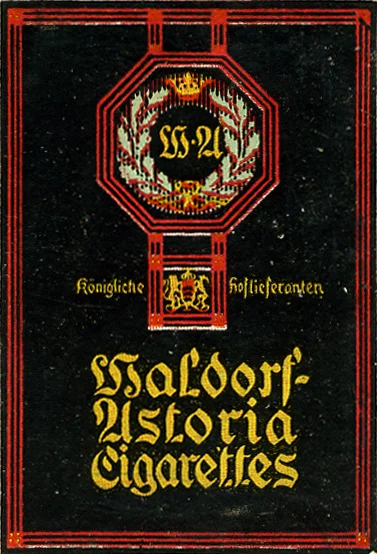
Now I’m going to tell you some things about the first Waldorf school that you might not believe. The first Waldorf school was started in 1919, a hundred years ago, in the German city of Stuttgart. It wasn’t a stand alone school. It wasn’t like this school; this school is just sitting here on this beautiful hill surrounded by pine trees, just getting by on its own. It was connected to a bunch of people who were producing cigarettes at the Waldorf Astoria Cigarette factory. The owner of the cigarette factory dedicated a percentage of the profits to pay the tuition for all the worker’s children and also to welcome children from other families into the school. This is the first thing about the Waldorf school that isn’t widely known. You have the school and you have a cigarette factory.
Then, by 1920, there are about 18 corporations connected with the Waldorf school. There is a pharmaceutical company, a manufacturer of agricultural equipment, a chemical plant, multiple farms, a bank, an oil producer, a wheat and grain mill. However they’re not only supporting this school with their profits, there is also a clinic and a scientific research institute. And they’re all connected together in one association. This is the first conscious experiment in associative economics.
Rudolf Steiner had written a book on sociology called Towards Social Renewal. It was a best seller in Europe and was reviewed in 1923 by the New York Times. The Waldorf school movement is one part of a big social-political movement that was partly articulated in that book. So how did Rudolf Steiner answer the question: How do you organize society so that the potential for goodness in human beings is most likely to become manifest? He didn’t actually put forward a solution that was similar to the Democratic or Republican parties. And that’s why I’m so interested, because I know those solutions so well. They are terribly tired thought forms, and I like novelty!
I’m going to try to walk you through 3 really interesting characteristics of associative economics, and tell you about how they were connected to the first Waldorf school. The first characteristic is that: in economic life there needs to be concrete association between producers, distributors, and consumers. That may sound abstract, but I hope you’ll appreciate it after I say a little more.

One of the most influential forms of associative economics is the Community Supported Agricultural movement. At least one of its origins comes from associative economic practices in Europe. The other one seems to come from Japan, the origins of which I’m less familiar with. They seem to have come to the United States at the same time. So what happens, for instance, if all of you are interested in having food as consumers, and I’m a farmer. I have this little farm at the bottom of this little school? I could make a budget, and I could list everything that I needed, from tractors to seed to manure, and I could tally all that up and say, ‘I can grow enough food that I could give you all a basket of food every week during the growing season, and a smaller basket in the winter if I have a greenhouse, but I need a $107,000. And if there’s a drought I’m not sure I’ll come through, and if there’s a blight I’m not sure I’ll come through, but I’m actually pretty good at farming. Then we could pass the piece of paper around and everyone could say what they’re willing to contribute on a monthly basis, and I could say ‘Wow, we’re at $98,000.’ And then we could pass it around again, and then you might get more. And this is actually how the first CSAs were funded in the United States. You can find it described in Farms of Tomorrow by Trauger Groh.
Because everyone has concrete knowledge of production, distribution, and consumption process in local agriculture, they may be willing to pay more for food. The price changes. Right now, when you go to the grocery store, there’s a part of the grocery store where you have some knowledge about the production. It’s the organic section, it’s the fair trade section, it’s wherever there are sustainability labels and any other label that tells you something about the production process. And you know what, people pay more for those. They’ll pay more. Steiner suggested the sociological hypothesis that reveals a fundamental error of most capitalistic theories. They don’t recognize how association, if you have practices of association, like in the CSA movement, actually can lead to people paying more and maybe consuming less. And they don’t necessarily feel like they’re torturing themselves. They’re not necessarily saints, or the virtuous few that Friedman refers to. Steiner suggested there is a counter to egotism in the economy through association (Tocqueville’s study of American democracy, that focuses so heavily on the art of association, is really interesting to read from this perspective). Can you follow that? It counters egotism. A social sentiment is activated through associative economics. Already here you see one concrete objection from Steiner to Milton Friedman: ‘No, human nature can be better. We can develop relationships that are more social, but we have to talk about the way we produce, distribute, and consume things to come to the right price.’
The second principle is separating income from work. I was recently hired to teach at the University at Albany as an adjunct in the political science department and my first paycheck came a month after I started teaching. It wasn’t much so it didn’t really matter but I was shocked that they would wait that long to give me any money! I had worked so hard already. Now let me give you another example. RSF Social Finance is an impact investing group in San Francisco, California. They are working with hundreds of millions of dollars, mostly in the form of investments and loans, but also some grants and donations. When you get a job at RSF, just about on your first day of work you get a paycheck. And they tell you ‘This is so that you can meet your needs so you can do good work with us.’ Consider the question, “What do you work for?” in this light. Not for money. Money is only a means so you can take care of yourself while you do good work.
Steiner saw that one core economic problem is the wage. It makes people believe they are not working for one another, helping one another, which we are all doing all the time. We think we’re working for money. And so even the way that we give pay can counter this misconception. We give pay so that people can be supported while they work. And what do you work for? Well, in your case, you’re doing God’s work here at Emerson—helping young people develop into free people. That’s way more important than working for money. That’s what the work is all about. The money is just a way you can take care of yourself so you can do that work. And this is important when it comes to finding colleagues. You want colleagues that don’t simply want the money, you want people that want to do the work. If you see someone come in, and they’re lit up about the work, that’s the person you want. Not the one that starts talking about pay right away.
It is interesting to think about this and to read Michael Sandel’s book What Money Can’t Buy. He’s a political philosopher at Harvard, who has investigated some of these issues, but Steiner’s notion adds a whole different dimension to Sandel’s findings. Again, separating income from work. This is another way you can organize collective life to help more goodness arise, taking what was mere potential in the human being and making it active and real.
The third principle: neutralize capital. The first Waldorf school was connected to 18 or so corporate enterprises that were producing things—from cardboard, to oil, to wheat, to agricultural equipment. The owners of these enterprises, when they joined this association, which was called “The Coming Day,” agreed to include themselves in the budget on a fixed salary. Typically, the way we think about corporate ownership is that if you own a corporation, and you make profits, you can give yourself raises and create profit-sharing structures. You get more money as your business becomes more profitable. This isn’t something you do only in your typical private enterprise, but also in many cooperatives. If you have, for instance, a grocery store coop, you can have a profit-sharing structure. Steiner saw this as a structure that encouraged anti-social sentiments and thoughts. Rather, give people what they need! Everyone is on a salary that allows them to have a dignified life, and then any profits and capital that are created, they are a social asset, a social commodity. So the owners were salaried. Then 5% of each corporation’s profit goes to fund a clinic, a school, a research institute. It should be understood that this 5% was only a beginning. But Steiner was adamant to make a start, and he was the chair of the association. The leading thought is that this 5% is given not because the managers of the company are great philanthropists! No, it wasn’t their capital! The profit was created through the division of labor, and all these corporations were possible because of that division of labor—all that profit, it was everybody’s! So it should go towards the common good. And what is the common good? The best schools we can have. And for who? For everybody. You all understand. This was recently described very well from another perspective by Armin Steuernagel in a TedX talk.
The Coming Day association failed, it dissolved because of hyperinflation within three years. They set up the structure and started to work together, but if you know anything about Germany in 1921-22, you know this is not an easy time to try something like this. I would say that it was not a fair time to test this because of hyperinflation. Steiner had nothing to do with the decision of the German government to print huge amounts of money with no regard for economic productivity in Germany. That was up to the politicians who were in charge at that time between the First and the Second World War. But The Coming Day association could certainly not escape the consequences of such inflation. And they dissolved the association to save the Waldorf school, as well as a company called Weleda. Perhaps you’ve heard of Weleda, it’s one of the oldest natural pharmaceutical production companies in Europe. It’s very successful to this day, and it was in the association.
These are just three of the characteristics of associative economics, but can you get a flavor of them? And it’s really interesting when you look at the difference between these characteristics and the suggestions for organization that we often hear from the Democratic and Republican parties, and you see how interesting this actually is as an idea for organizing corporate life. This is actually about organizing the economy. But you know what, it’s conceived of as voluntary. And you say ‘Oh you’re crazy! Those corporate people, they’re so egotistical, they’ll never do this!’ Maybe you won’t say that, but I have talked to many people who have this response right off. But one of the most fascinating things about Rudolf Steiner’s insights in Towards Social Renewal is that they weren’t simply connected to revolution or reform. He said ‘This is what's happening, society is dividing us into three parts, and this is how I think we can best work with it.’ It’s dividing into an economic sector, which should be guided by associative economics, a political sector, which should be guided by democracy, and a cultural sector, which should be independent and free. Now I would like to point out that we definitely have an economic sector in the United States, that’s just one part of a global economy, we have a democratic government, which is intended to be an area where legislation is created, and we have civil society, a cultural sector which includes Emerson Waldorf School, Harvard, Wikipedia, public radio, and all the churches around here, and all the philanthropic foundations.
And now, I would like to point out that this is where I find Steiner so interesting, because in one way his study, Towards Social Renewal, is prophetic. He says ‘No! No! The real principle of economic life is not competition, it’s cooperation, without government central planning.’ And do you know some of the fastest growing innovations in American corporations right now are fair trade and benefit corporations? These are manifestations of what Steiner suggested a century ago. They align with some of the ideals for corporate life that Steiner indicates in Towards Social Renewal. But they also happen to align with what Jeffrey Sachs, the American economist who is working with the UN on the sustainable development goals, is articulating. That we should be working for three bottom lines in the economy—namely profit, positive social impact, and positive ecological impact—and these are only possible where there is good governance, no corruption, and transformed self-interest.
If you want to start a business you can now incorporate as a benefit corporation in almost 40 states in the US. Benefit corporations writes into their incorporation papers these audit practices, and every year they show that what they’re doing is beneficial for society, ecology, and for the ‘pocketbook.’ How can we work together to make good things? That’s the benefit corporation’s model.
You can see when you look at society that it is indeed dividing into three parts: a global economy, a democratic government, and an independent cultural life. You can see the tendency that Steiner was talking about, and he was writing in 1917-18 in Germany, after WWI. And he said this is going to become more and more the case in the future because of the industrial revolution and other factors that are playing themselves out in modern society.
So in a way, this Waldorf school is a bit of an orphan. From the perspective of the bigger social-political movement from which it was born, every Waldorf school is an orphan. One of the teachers who founded the school I live near, which is the Hawthorne Valley School, was Karl Ege. He was hired by Rudolf Steiner at the first Waldorf school in Stuttgart. He was a very young teacher at that time. He attended some youth events where Steiner spoke and, at one of these, one of the young teachers came to Steiner—this was after The Coming Day association had dissolved and many schools had to charge tuition to finance the schools—and said, ‘How can you justify charging tuition and not allowing people who don’t have money to develop themselves? How can you justify this?’ This is a very serious moral question. And Steiner said this, ‘It is a social lie what we are doing, but until the threefold social order can be created in some form, I don’t see another way to deal with the situation.’ And you see in the Waldorf movement in the United States that people fall on two sides of this. Some people say ‘I will give up independence (which is the free life of the mind) for accessibility, and I’ll work in the charter school movement of public schools.’ Then you are regulated in how you can teach, but you get students from all over society. You have total accessibility, which is certainly right. The first students of the Waldorf movement were children of the cigarette factory workers. The whole intention was to make it accessible for the working class.
Then, on the other hand, you have the independent school movement, which is able to maintain its integrity and its practice of pedagogy, fiercely sometimes, because it will not take any money from the government. But because of that they become privileged, exclusive spaces in society. But we have to imagine the scope of the intentions of this movement. Between 1920 and 1930 Rudolf Steiner wanted hundreds and hundreds of Waldorf schools to open in Europe. I’m trying to give you some picture of scale. This association I’m telling you about, with 18 corporations, there would need to be an association like that connected to every school. That’s the scale of the social movement Steiner was imagining. In scale it is like what Bernie Sanders is trying to do, not merely with the old trade union spirit, but rather with associative economics. Today there are a thousand Waldorf schools around the world, which is something to be thankful for, particularly if you think of what happened to Germany in the 1940s, when all the Waldorf schools were shut down. Now we have a thousand Waldorf schools. I’ll still be thankful for that even if they are orphans.
So again, like King asks, in essence, How can you organize society so the potential for goodness can be more manifested than it is right now? Steiner suggested that through associative economics you can counter egotism in corporate life, through, in part, the practices we have covered. He also advocated for a very specific direction in education which I think you probably know much more about—for instance, what I mentioned before about an artistic or aesthetic education. That is also a way of helping the potential goodness in people manifest more.
It’s really exciting when you think about it. And I’m so happy that there are places out there where these associative principles are being actualized, from RSF Social Finance in California, to the Sekem corporation in Egypt, to some of the ethical banks in Europe where every investment is public. So you know where all your money is invested, where it is working, what it is doing while you are sleeping at night. One time I got a call from my bank, and they said ‘Hi, we see that you made a visit to the branch recently. We just wanted to get a little feedback. Are there any recommendations you have for the bank?’ I said, ‘Yeah! Would you mind just publishing all of your investments publicly so I can see what you’re doing with my money?’ She replied, ‘Thank you for that…’ and that was the end of that conversation. It was Key Bank and they haven’t done that yet. So when we think about all these public school teachers who are gathering in Raleigh, I hope that even though they are dealing with very different things, we can see that we’re all caught up in the same problem. If you’re a public school teacher fighting for freedom and dignified pay through civil disobedience or a Waldorf teacher trying to offer a dignified education in a private setting like this—this is one societal problem.
I feel a huge amount of optimism related to these ideas. I’m also aware of the unbelievable amount of work that endeavors like this require. But tonight when we gather together to remember the beginning of the Waldorf school movement, which was a hundred years ago this year, it is good to call all these things to mind. It is good that we have the courage at least to look at the big picture, and the social and political facets of this movement. I really appreciate this. I hope it was lucid enough for you to feel what interests me about it, and how it is related to contemporary public discourse in the United States. It is great to be here, I’m really happy to see what’s going on in the high school. Thank you so much.
Can everything be art?
Growing up at the end of the 20th century I remember taking art classes and hearing that everything could be art. As a teenager I was inspired by this notion, as were many people my age, that all of life could be infused with a feeling of meaning and inspiration. “Everything can be Art,” like any slogan, is only as wise as the context in which it appears. And most of the contexts in which I have encountered this slogan have revealed its mind-numbing power, which amounts to the feeling: “If everything is art, then there is no discerning it.”
BY NATHANIEL WILLIAMS
Growing up at the end of the 20th century I remember taking art classes and hearing that everything could be art. As a teenager I was inspired by this notion, as were many people my age, that all of life could be infused with a feeling of meaning and inspiration. “Everything can be Art,” like any slogan, is only as wise as the context in which it appears. And most of the contexts in which I have encountered this slogan have revealed its mind-numbing power, which amounts to the feeling: “If everything is art, then there is no discerning it.”
One of the most famous artists of the last century to work with this thought was Jospeh Beuys. With Beuys I have come to respect a deeper perspective in this attitude, one that grasps the creative dimension of all production, from art to the collaborative production of the global economy. When we think about art, typically, we think about culture, about creativity, intelligence and skill. After World War II Beuys was convinced that the life of intrinsically motivated productivity had to once again be sensed all the way down into the economic productive areas of society, and that delicate notions of art that focused on art objects, museums, galleries, and artifacts could offer no redemptive power to the crises of modern society.
Before we go into this in any detail we can bring to mind some experiences of intrinsically driven, creative freedom.
Some years ago I was hired to teach stone sculpture to a group of seniors at a school in the Pioneer Valley in Massachusetts. The class was outdoors at the foot of the Holyoke mountain range. The mountains make their run from east to west, which is unusual, and have a fluidity to their appearance on the horizon. It was one of the most beautiful workshop settings I’ve ever had. Each student chose from a pile of rough marble blocks. After cutting swaths of linen and sewing our own sand bags to use for propping the stones, we created tripods from saplings. We set the stones on the tripods and went to work with point chisels. The task was to develop the natural shape of the stone into a non-representational sculpture. Each student was to draw an emergent composition of interrelated concave and convex areas out of the rough rock. Working under these mountains, staring at the various stones of the student’s and seeing the potential in each, had a strong effect on me. I commuted to the school each week from the Hudson Valley in New York. One afternoon fresh from class on my westward drive, powerful images and lines of poetry started to come to me. They were carried by a vital urgency, like a pulse of life. The rest of my day and plans receded before this strange vital joy. I parked on the shoulder of the highway.
“The sun reaches down with its warm arms and fluffs lake water into clouds.”
This is all I got. I pulled back on the road. Within minutes more lines and images were pressing in on me. I pulled over again. This repeated itself and in the end there was a poem.
The sun reaches down with its warm arms
And fluffs lake water into clouds
With which it pads the sky
That our hard skulls wander through.
It planted two sun seeds on that rock
Which blossomed into eyes,
Like mouths of a cave,
And the moon looked inside.
Then the sun took its bow and
Stretched it broad with shafts between
Letting them fly through the cave eyes.
They punctured the soul’s dark walls
And continued to the center of the earth ball.
From these holes in the dark ground of the soul
Delicate light, like stars in a desert sky, shone,
And they grew, turning inside out
To become half diamonds, half morning dew.
The sun reaches down with its warm arms
And fluffs water into clouds
With which it pads the sky
That our skulls wander through
Skulls with eyes, eyes shining dew drops and starry skies.
It is an odd poem. I am unsure of its merits. But the experience of its emergence will be familiar to many artists. Years later I read an interview with Tom Waits. He related how he was driving down an eight-lane highway in LA when a song approached. Frustrated at the capricious nature of the muse he turned to the sky and shouted: “Excuse me. Can you not see that I'm driving? If you're serious about wanting to exist then I spend eight hours a day in the studio. You're welcome to come and visit me when I'm sitting at my piano. Otherwise, leave me alone and go bother Leonard Cohen.”
This type of experience, where a creator senses they are in the presence of an inspiration that appears with its own life and spontaneity, its own urgency and reality, is also one of the reasons that an artist can remain intrigued by the work of art. It is, of course, not always so clear, and sometimes is dully sensed below an intense process of drafts and revisions. But there is a basic feeling that there is a life that has a relative independence. And it is connected to a feeling that creations are also visitations, or explorations, of a field of experience that does not totally coincide with day-to-day logic or planning. These are visitations of the future world, and one participates in bringing it into the present.
One group of researchers from Harvard Business School studied the qualities of such inspired works of art. They enlisted 23 professional artists, asking them to randomly select 10 commissioned works and 10 non-commissioned works. Art is not always created out of the inspiration of the artist; it can also be created by dictate. One can say, we need art, let there be art. One can pay an artist and tell them what one desires. The researchers wanted to see if there was a difference between works that were the result of extrinsic motivation (some outer reward or punishment) or intrinsic motivation (inner enthusiasm and inspiration). All the works were then blind-judged by a panel of artists and curators, in the two categories of creativity and technical skill. The panel found no difference between the two groupings of the art when it came to technical skill but found that the non-commissioned works were significantly more creative.
Freedom, acting out of the singular law of inspiration, shows in the the work itself. One’s ability to be creative appears to be connected in some way to the freedom one is granted while creating. The quality of living, inspired culture seems to be connected to the idiosyncratic emergence of art. Liberty and living culture seem connected.
Perhaps it is also this love that the creator directs toward their work, a kind of loyalty, that gives those dedicated to the intrinsic life of creativity better chances at making it into a vocation. There was a long term study on intrinsic motivation where art students in Chicago where asked about their motivations for developing themselves in art school. Decades later there was follow up, to see if they had continued to pursue art. Artists who were intrinsically motivated were more able to integrate into the profession while those who were clearly extrinsically motivated often moved to other types of work. The permanence of creativity, over lifetimes, and its integration into society, appear tightly tied to one’s inner life being connected to one’s outer vocation.
In the most radical experiences of creativity we can characterize experiences where a person is regularly assailed by inspirations, whose end they can hardly explain, and which they want to follow out of an intrinsic interest and inner need. It can be sensed as a kind of evolutionary force, that wants to be made real and at the same time, even while in process, radiates reality over life and makes it worthwhile. I have focused on art, a type of creativity where the ultimate use and purpose of the creation is highly questionable, but the creative experience will be familiar to people working in any number of areas — as mathematicians, engineers, researchers, lawyers, or journalists.
In relation to creativity it is possible to characterize money in the following way: Money is simply a condition that allows one to be creative—to participate in the emergent future.
Obviously, one’s needs must be met so that one can create. Money gives us a claim on goods and services in the market. One can use money to pay rent and utilities, to buy food, to get materials and tools. In this way, money allows one to be creative. We can say people work for money but really it’s not true in many cases. Money is the example par excellence of extrinsic motivation, but with intrinsic motivation, one’s center of being is in the act, not the pay that might be connected to it.
Money can be felt as the freedom to be creative. We can think about how this differs from the feeling we have of money as a means to intensify consumption. As strange as this may seem in a society that seems to prize individualism over all else, it’s not hard to sense that our feeling for money as the means to fuel our consumption has taken the place of the feeling of money as the means to free our creative expression, our individual inspiration. And so our rapacious consumerism is directly connected to our deficit in living culture.
Once again, for the intrinsically motivated creator, money is sensed as a right to shape the future through freedom.
In the economy and in the very life and structure of corporations, the most obvious way culture shows up is as research and development. Here, again, I am connecting culture to individuation and intrinsic motivation of individuals. Some managers have consciously worked against over-planning and control in the workplace, as an open door to new life and insight. They have made moments of de-centralized production. In the 1950s, the president and chairman of 3M, William McKnight, included 15% time in the regular work week when workers were to put work aside to doodle and daydream. Post-it notes were born from such “experimental doodling.” More recently, Google has become well-known for encouraging developers to use as much as 20% of the workweek for projects of their choice, with no justifications, no businesses plans, and no vetting of ideas. As we saw with art, in the research and development wing of some corporations the future is being created.
This transition from individual inspiration to creative departments in corporations is not the greatest leap. Yet when we go one step further we find that even outside of these creative departments, while in a very different way, all work is future oriented.
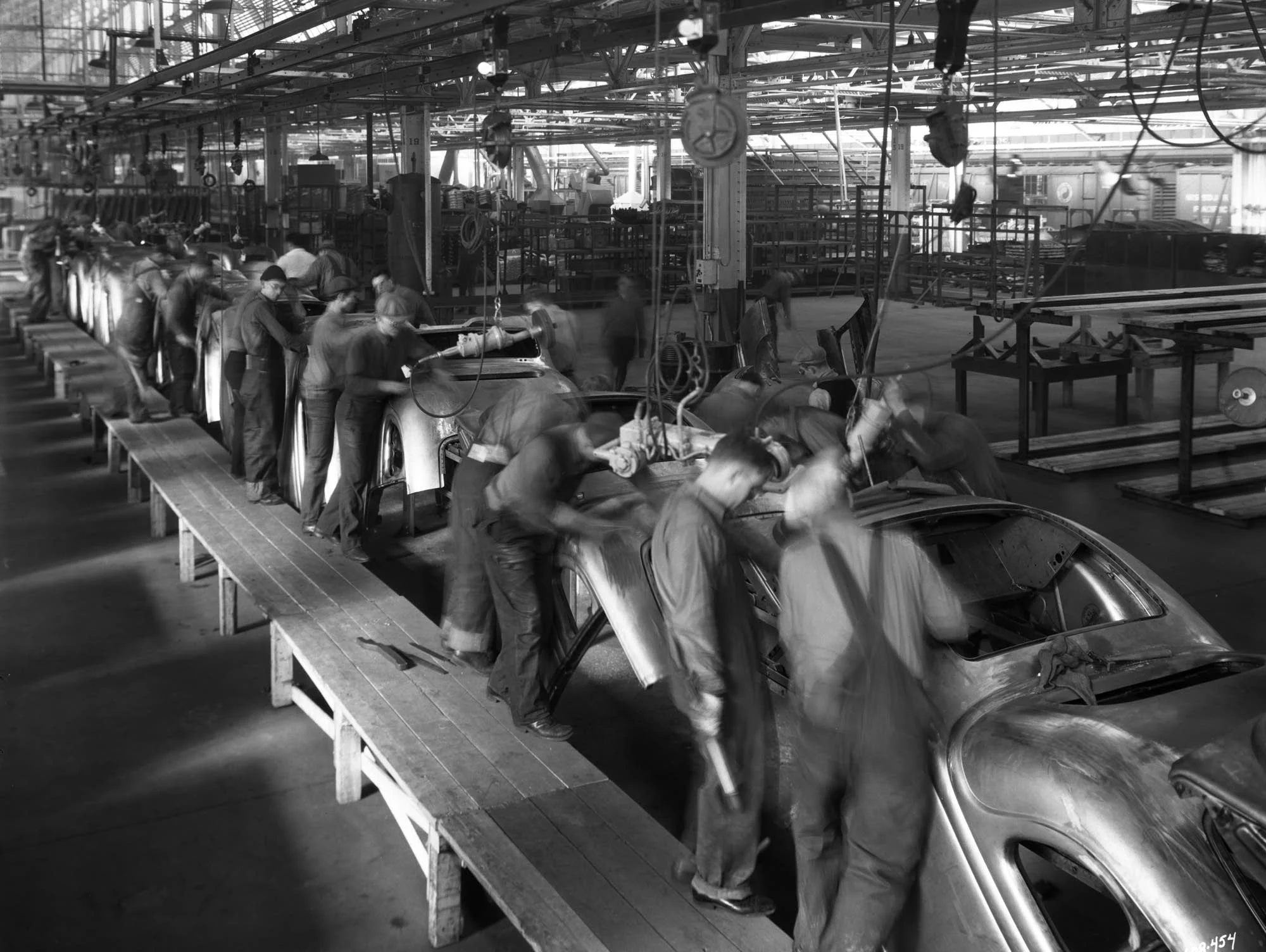
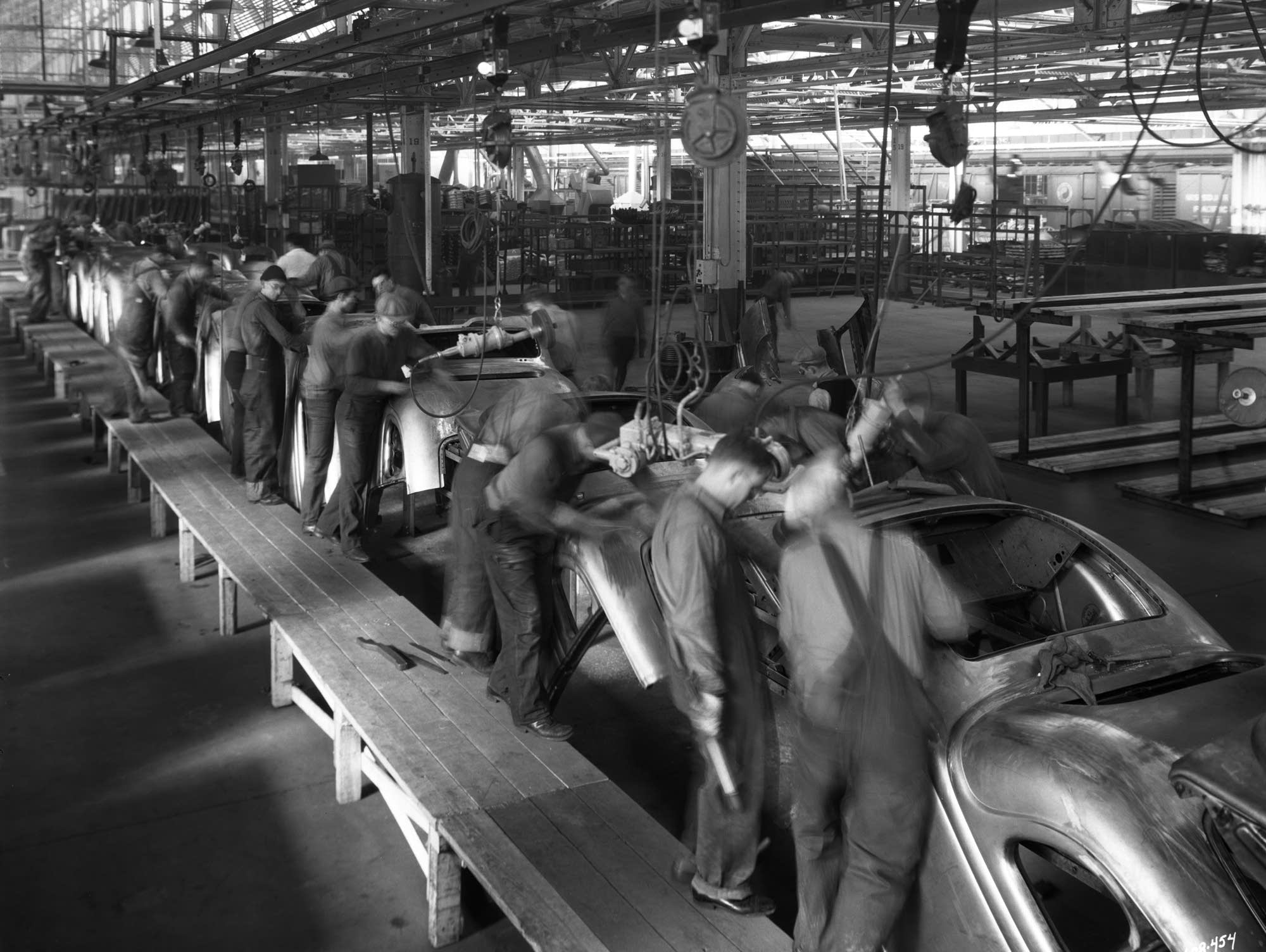
But what about areas of society that demonstrate the least amount of freedom? The way we organize the economy, through the division of labor and specialization, has led to extremely limited fields of action for countless people. One early genius in understanding the efficiency and productivity that intense cooperation holds was Henry Ford. He was one of the first industrialists to introduce the assembly line. The time it took to assemble a Model T dropped from 12 hours to 2.5 hours and made it possible to lower the prices on the cars and double wages for workers on the assembly line. It also transformed the experience of work and production. The experience of those working together to produce material goods became almost unbearable. Workers required less skill, and had less understanding and connection to their tasks. In Marx’s powerful image people are reduced to appendages of the machine. Creativity and individuation are severely limited and the connection between the producer and any intrinsic meaning in their activity dries up. Because of the limited and relatively simple nature of the task in an assembly line, one need not even understand the overall project one is working on. One hundred years after Ford’s assembly line—a time of rapidly increasing specialization and intensification within the global economy—many people work without having a concrete understanding of their contribution to the future. Here, where the process of cooperation, collaboration, and specialization have been driven to an extreme, the intrinsic creative experience of production is most obscured. These basic observations led Marx to his notions of alienation, both from the fruits of our labor and from each other.
What does one work for then? Here we can see how one could come to work for money. The act of production becomes so void of meaning that only the monetary incentive remains. The stultifying effect of intense, extrinsically motivated production has the power to atrophy the very fount of creative motivation. One comes to understands one’s labor as a commodity. There is a market on which one can sell one’s creativity. What does one work for? The pay. What is the pay for? Food, shelter, healthcare, and clothing. The old labor chant captures this culture of work: “We go to work, to get the cash, to buy the food, to get the strength, to go to work, to get the cash….” While the productivity that has been made possible is stunning, the work itself is experienced as soul-killing drudgery that does not fill the worker with any meaning. The meaning of life is shifted toward getting paid in order to fulfill responsibilities: paying bills, providing for one’s family, surviving. (I once talked to a teenager about this who likened it to a very bad cyclical video game.) Or you might not be poor, you could be well-off. Then you purchase more goods and have a more luxurious life style. Here, alienation casts a shadow over one's "leisure" time as well, replacing creative activity and social connections with consumerism. These extremes of work culture appear to have lost all nuances of freedom and realizing one’s creativity. One is not inspired nor does one sense one is fulfilling a larger good by serving some need in the world. One’s aspirations can easily become tilted toward more and more private, personal well-being.
Not all businesses are satisfied with this. In an Egyptian corporation called Sekem, the workers gather together in a circle before work and each says their name and how they are contributing to the creative production of the collaborative enterprise. This allows the common project to be grasped by each person, each contributor. Thus, the intrinsic good of the enterprise is able to remain in the consciousness of the workers. The work itself is a good, not only their pay. Under these circumstances, when workers receive money they can understand it as a means to meet their own needs so they can continue collaborating with others in meaningful work. But here something very interesting arises. The intrinsic motivation is now connected not to intense processes of individuation but to intense cooperative processes and interdependence. Intrinsically motivated work in this area has the quality of team work, solidarity, and mutuality. Serving a need through working together with others can touch the deepest chords of our humanity. In Small is Beautiful, E. F. Schumacher has pointed out in discussing right livelihood, that even if work is not required from a material perspective, ignoring the moral, social dimension of work is perilous. Rudolf Steiner suggested in his study of economics that the emergent virtue in the modern economy was fraternity, while in culture it was liberty, which is certainly illuminating from the perspective we have taken here.
Now let us return to our earlier perspective, that money is a right to participate in the creation of the future. Here in this Egyptian corporation, which is large and specialized, money can still be interpreted as the right to be part of creating the future. One receives pay so that one can return and do good work. (In food production, it is quite literally creating the future through meeting the immediate needs of others in the coming weeks). This view of work in the modern economy has a quality that touches the core of creativity, if in a different degree than the examples I opened this consideration with. While I am not suggesting that it is in anyway exhaustive to understand money an opportunity in creating the future, it does seem to me to be typical of a cultural perspective on money and work.
While one can say that all money can be interpreted as a potential to be creative, there is a spectrum of permanence and influence that runs from the production and daily consumption of commodities to the life of culture. On the side of culture the intensity of future creation is high, on the side of commodity production it is lower. On one side, that of social and cultural work, the future bearing power of investment grows as the “return” becomes more obscure, on the other side, that of commodity production, short-term gains skyrocket and long-term transformative power wanes. In the production of commodities and perishable goods, one creates a future where needs are met in the immediate: i.e. a person is fed, and production repeats itself in a predictable fashion. When working in research and development one creates a future that is perhaps five or twenty years out, and novelty is central. A work of art, unlike other physical objects, can last generations, a gateway for countless people to experience aspects of the good, beautiful, and meaningful. Works of art are the experiential essence of singularity—of an object that carries the totality of its significance within itself from age to age. In Arendt’s greatest work she reflects, “Because of their outstanding permanence, works of art are the most intensely worldly of all tangible things; their durability is almost untouched by the corroding effect of natural process, since they are not subject to the use of living creatures, a use which, indeed, far from actualizing their own inherent purpose — as the purpose of the chair is actualized when it is sat upon — can only destroy them.” This aspect of creating the future has effects that are active in ways that a loaf of bread cannot be. Yet all are acts of creating a meaningful future.
Directing resources towards social and cultural work reaches the furthest into the future. It is the greatest fulcrum for transformation. More specifically, the greatest fulcrum for transformation is arguably education, attending to the innate abilities and gifts of the growing generation. Moreover, given the character of creativity one can see how desirable it would be to have schools that do not educate children to be employees for existing enterprises, or citizens with definite political allegiances, but instead help foster the intrinsic interests and abilities of the maturing generation. From an economic perspective the return on this kind of education is immense. It is actually easy to understand the goal of supporting schools and cultural initiatives for their own sakes. We may not sense what exactly the economic return will be, but we can understand that this is to be expected if we believe in freedom and its positive power. The children belong to a world that we cannot picture as it does not yet exist. We can, however, foster their innate abilities and the spirit of freedom in them so that they can create it.
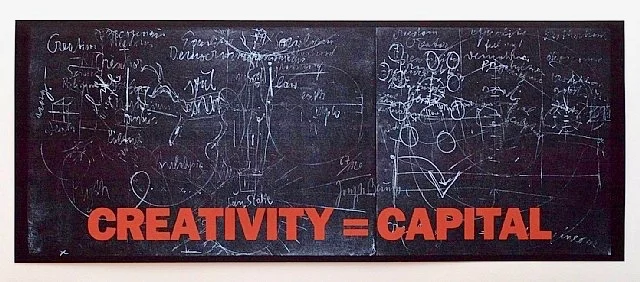
Perhaps now it is time to get back to the point. Not far from where I live there are works from Joseph Beuys on display. One piece is like a ruin at a building site. All told it is not really present. They are the remains of events he called social sculptures. In one of his early works he packed lard in the corner of a cardboard box and engaged passersby in conversation. They might call out; “Beuys, this is bullshit,” to which he would reply, “What do you think then if it is bullshit?” and he would follow his critics around trying to continue the exchange. He saw his greatest achievement in his revisioning art to include all of life, a vision he captured with the slogan “Everyone is an artist!” and the more esoteric formula “art = capital” or “creativity = capital.” This was also the unique tone he brought into the founding of the green party.
In an age of cynicism it is easy to see Beuys as a charismatic snake oil salesman and a charlatan, but if there is any merit to this I do not think it is in his understanding of the relationship between art and capital. He saw a devastating challenge in the fact that our economic life is estranged from our sense of agency, creativity, and productivity. He was an enthusiast of the social and political theory of Rudolf Steiner. Rudolf Steiner characterized the cultural, creative life as existing in society on a spectrum that went from education, through the “half free spiritual life” of technological research and development, to the life of the economy, which is the ability of the worker and producer to exercise their productive skills freely toward a socially valuable end. Understanding this reveals we do not have to think about labor as a commodity. Pay can be understood and implemented as a provision of means whereby something new can be created or produced. This is the spirit of freedom in the economy—when everyone who is involved in production feels, I am playing a part in producing for a tomorrow that I feel is worthy of human beings and the earth. While the modern economy is the least free facet of society, this feeling of creative participation needn’t be excluded from it. Moreover it offers the greatest potential for intrinsic motivation characterized by the virtues of fraternity and solidarity. As Schumacher observed, these cannot be generated by pure liberty. In a corporation like Sekem, which strives to embody this notion of economics, work should still carry the feeling of liberty, of being intrinsically worthy. Each worker should be able to sense the virtue of their cooperation as they engage in the process of production. And when they are paid they should not only feel they are making good on their bills, but also that they are thereby freed up to return to the site of production and work toward a better tomorrow.
Understanding the role of freedom, creativity, and culture can help us imagine new ways of organizing society. This view on culture reveals how important the socialization of capital is, the reform of current intellectual property laws, and the organization of independent cultural associations who can steward capital by investing in emergent projects and the emerging generation. The socialization of capital can be achieved through directing a greater share of the profits generated by businesses to foundations dedicated to investing in independent and accessible culture. Forms of democratic philanthropy and foundations which delegate giving in a specific field to cultural leaders in that field, can serve as conduits for socialized capital.
But one of the most important fruits of this view on culture relates to the economy. Can we associate and cooperate together so that as producers and consumers we are aware of our interconnections and so that each day at work we feel we are creating the future in concert with others? This would be freedom in cooperation. This would be re-incorporating part of our productive life that has fallen outside our humanity. This would be feeling that everyone who is being productive is creating the future in some way, and a way that can intrinsically motivate them. This would give meaning to the slogan “Everyone is an Artist” and make clear that wages, salaries, and fees are rights that enable one to participate in the creation of the future.
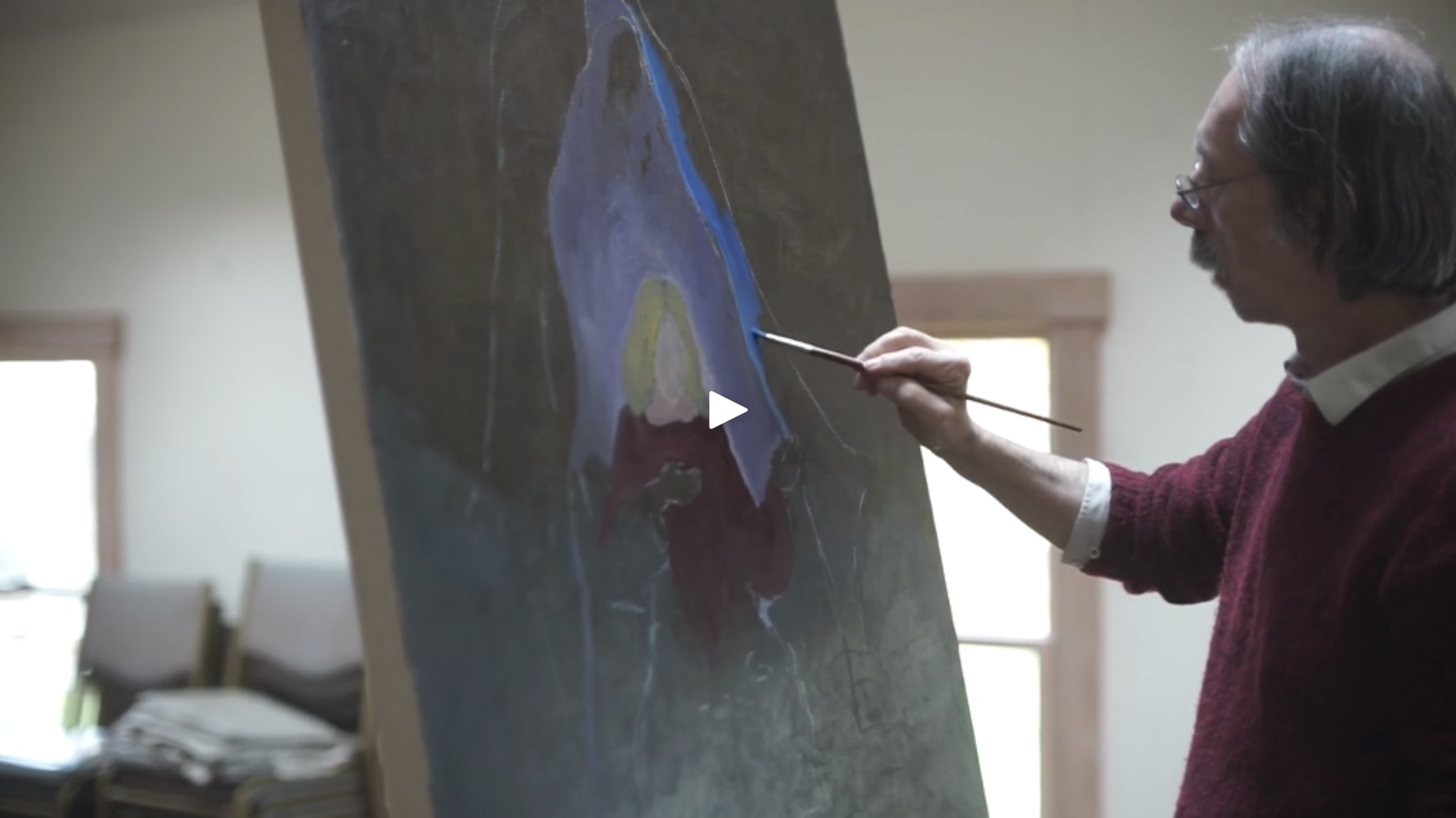
The Cultivation of Site-Specific Artwork
An artist, perhaps a faculty member at Free Columbia or someone participating in an ART / Capital Residency, may offer to work with an institution in order to create a work of art that fits their organizational mission and their working space.
There is a discussion between the artist and members of the institution about what is needed. The artist is left free to create something new and the institution is free to make a contribution to Free Columbia. In November, 2018, Zoltán Döbröntei, a painter from Budapest, Hungary, created site-specific work for the Community Hospice in Catskill, NY; the Rudolf Steiner Library in Hudson, NY; and the new High Falls Theater in Philmont, NY, as part of the ART / Capital Residency.
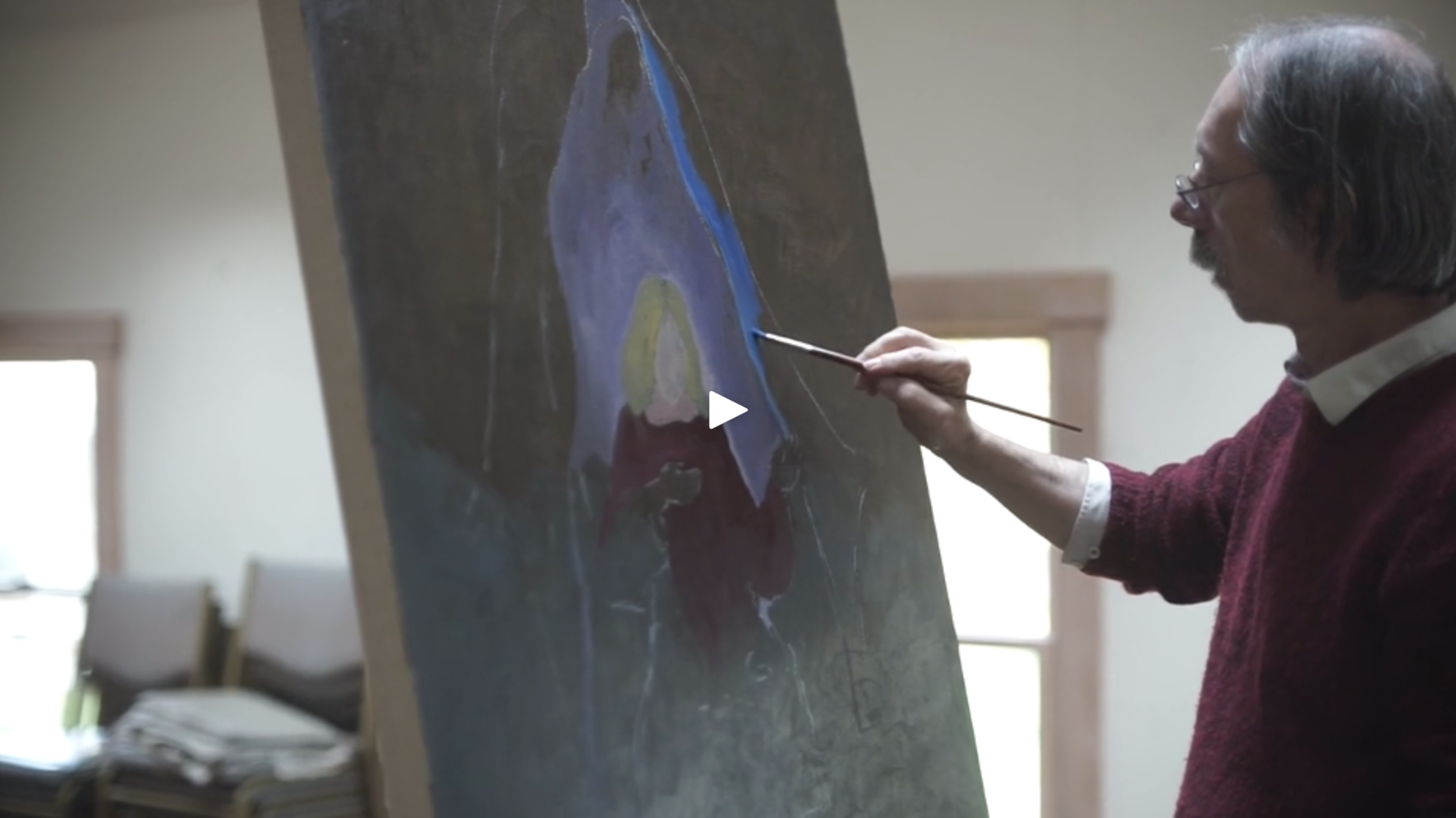
As a part of the Art / Capital Residency, the painter Zoltán Döbröntei was hosted by Lightforms and Free Columbia for one month to paint three site-specific pieces. Video by Caleb Buchbinder.
ART / Capital Residency (2018)
A Free Columbia / Lightforms Collaboration
“Money and capital cannot be an economic value, capital is human dignity and creativity. And so, in keeping with this, we need to develop a concept of money that allows creativity, or art, so to speak, to be capital. Art is capital.”
- Joseph Beuys
The ART / Capital residencies served as free cultural events. Artists were supported to create, and part of the residency included making the art available to the community at large. As with all activities at Free Columbia, donations are continually invited and accepted and will go toward supporting future projects. The intention is that creativity is placed in community context as a goal, as expressed in the new concept of capital referred to in the Beuys quote above.
ART / Capital Residency artists:
Jason Healy
Zoltán Döbröntei
Martina Angela Müller
Contact us if you’re interested in learning more about site-specific artwork or artist residencies.

The Chiemgauer
In the summer of 2015, I had the opportunity to visit the Chiemgau region in Southeast Germany that is home to the “Chiemgauer” currency project I had come across in The Guardian in 2011. Traveling to Salzburg and then westward toward Rosenheim, I enjoyed the landscapes and little village scenes opening outside the train window. Arriving in the village of Traunstein, I walked into a local bank to see about "purchasing" some Chiemgauer (exchanging it for Euros). The teller was well informed and happy to lead me through the details, offering me a small booklet that listed all the businesses that accepted the currency, and the not-for-profits that benefited from its use.

After visiting Chiemgau in 2015 I was inspired to produce Michael Ende's famous children's story Momo. This is a photo from a performance on the village green in Philmont, NY, part of a tour during the summer of 2016. From left to right are Michael Balin, Nao Kobayashi, and Gabriel Rodriguez. Nao is playing Momo.
In the summer of 2015, I had the opportunity to visit the Chiemgau region in Southeast Germany that is home to the “Chiemgauer” currency project I had come across in The Guardian in 2011. Traveling to Salzburg and then westward toward Rosenheim, I enjoyed the landscapes and little village scenes opening outside the train window. Arriving in the village of Traunstein, I walked into a local bank to see about "purchasing" some Chiemgauer (exchanging it for Euros). The teller was well informed and happy to lead me through the details, offering me a small booklet that listed all the businesses that accepted the currency, and the not-for-profits that benefited from its use.
I left the bank and set out to find the office where I was to meet some of the currency project’s board members. Eventually I came to a little park, passed a café on the street, and entered a building that led up to a second floor office space, containing two desks and a wooden coffee table. They were expecting me and greeted me with a warm welcome (and perhaps a bit of the thrill elicited when I tell people I am from a glamorous place called New York, though in my case this is rural Upstate New York, a land of rolling countryside far removed from the commonly held images of Times Square and city lights). I met with Peter Fochler, Christophe Levannier, and Elke Mathe, all intensively involved in the initiative. What a treat to hear in detail the ideals and successes of the project, and also future plans. One ongoing project was related to a film about Michael Ende and his famous book “Momo.” It was the dynamic forces of economic and cultural life that had inspired Ende to write the book, and indeed an illustration of Momo graces the Chiemgauer note. The Chiemgauer takes its name from the region that is its habitat. Indeed the Chiemgauer behaves more like a living/dying creature in a habitat than like a mere object of utility. No sooner is it “born” upon issuance, than it begins to depreciate at 8% annually, and expires (or dies) after two years in circulation. Moreover it has distinct life processes: when purchased, immediately 3% of the total purchased amount is directed toward a local not-for-profit of the buyer’s choice. One Chiemgaur is equivalent to one euro, so for every $100 Chiemgauer purchased 3 euros goes toward these community initiatives.

The initiators of the novel Chiemgauer “creature” are none other than a group of tenth graders and their economics teacher, Christian Gelleri. They designed the currency as a fundraising project for a Waldorf school, but predicted more far-reaching benefits. By adding a depreciation rate they were convinced that commercial relationships would increase at the local level, with the benefit of increased local solidarity and connectedness, and a reduction in the CO2 emissions and other waste resulting from transportation.
After leaving the invigorating conversation and warm hospitality of Peter, Christophe, and Elke (which included copious food and coffee), I met Christian Gelleri at a café near the train station. A tall slender man about 40 years old, he arrived on a bicycle and proceeded to further warm my heart with his enthusiasm and knowledge. He told me about the origins of the project in his tenth grade economics classes and about the repeated visits of Bernard Lietaer. Traveling through many areas of political theory, we discussed decaying money, the economic thought of Sylvio Gessel and Rudolf Steiner, and the movement for the threefold social order, famously championed by Rudolf Steiner and later Joseph Beuys. These ideas, especially the latter, directly inspired Gelleri and his students in creating the design that they did.
One result of this design is that the Chiemgauer circulates around 2.5 x faster than the euro. Upon receiving a bill one uses it more quickly. While our habitual way of thinking might suggest this is good because it means more business, there are more interesting and subtle facets of this fact. Consider for instance that in making money into another perishable good, it loses some of its aura as a super commodity. It rusts like iron, it molds like bread.
This may raise the concern that increasing trade will simply increase excessive consumerism; yet another potential exists in the increased velocity accompanying the decaying Chimgauer: it educates its user to remain conscious of the perishable nature of economic life. Thus it has the potential to foster a more ecological and sustainable awareness that acknowledges the finitude and perishability of our lives in so far as we produce and consume. Accompanied by the right inner orientation this weakening of the storage function of money liberates one to look for investments that last. Investing in common spaces, public art works, culture and education all appear in a more clear and definite light, as the true sources of wealth and the true capital of a community.
“Money and capital cannot be an economic value, capital is human dignity and creativity. And so, in keeping with this, we need to develop a concept of money that allows creativity, or art, so to speak, to be capital. Art is capital." — Joseph Beuys, What is Art?
What's possible? Two crucial aspirations for social theory
The 2018 Bread and Puppet Tour is coming through Hudson, NY, with The Basic Bye-bye Show. Peter Schumann has based it “on the fact that our culture is saying its basic bye-bye to Mother Earth by continuing the devastating effects of the global economy on our planet—which is why our show proclaims the Possibilitarian’s basic bye-bye to capitalism in order to welcome the 1000 alternatives to this rotten system.” How true and absurd at the same time, this cocktail of profundity and whimsicality we have come to expect from Bread and Puppet!
The 2018 Bread and Puppet Tour is coming through Hudson, NY, with The Basic Bye-bye Show. Peter Schumann has based it “on the fact that our culture is saying its basic bye-bye to Mother Earth by continuing the devastating effects of the global economy on our planet—which is why our show proclaims the Possibilitarian’s basic bye-bye to capitalism in order to welcome the 1000 alternatives to this rotten system.” How true and absurd at the same time, this cocktail of profundity and whimsicality we have come to expect from Bread and Puppet!
True? Only the most blatant deniers of reality still claim that the economically-induced ecological crisis is a hoax.
Absurd? Well yes, the notion that there are 1000 alternatives to capitalism will strike many as absurd, whimsical. A widely held opinion, certainly among economists and also among the populations they preach to, has declared that unchangeable (one might even say “natural”) laws rule the economy, laws we must simply accommodate: though we may wish to create a more humane society, this wish is immature and futile in light of what we “know” about human nature and economic laws.
Enter Schumann and the “Possibilitarian” movement of cardboard puppets and puppeteers. Why attend the show? Are we merely indulging a whimsical desire to support the doll-wiggling fiddle player in his defiance of the austere, organized, and well-groomed political economists? Are we seeking escape from a dire reality, a release that might renew us for a moment, inspiring small acts of kindness and creativity immediately following the experience, yet making minimal impact on the iron laws of economy?
Maybe—but the deep irony is that our fatalistic attitude is under-examined, and thus underdeveloped. What if we really can co-create our society through what we think? The economist and Nobel Laureate Joseph Stiglitz described the dominant fatalism in “America's graduate schools, despite evidence to the contrary” as “testimony to a triumph of ideology over science.” (And he further lamented the fact that “students of these graduate programs now act as policymakers in many countries, and are trying to implement programs based on the ideas that have come to be called market fundamentalism.”) But Stiglitz points out that the paradigmatic economic theories founded on the “law” of the selfish human being did not prove wrong across the board: in an intriguing twist of plot, “it appears (at least in experimental situations) that experimental subjects are not as selfish as economists have hypothesized, except for one group—the economists themselves.”
One simple conclusion to draw from these experiments is that what we think… actually matters! And when it comes to how we conduct our economic, political, and social affairs we play a part in how, and what, we think. Economists, who develop and articulate and “think” theories of market fundamentalism year in and year out, have contributed to realizing it in actual fact. They are the subject group that has come furthest in realizing homo-economicus. In thinking and re-thinking rational choice theories, their very actions have become aligned with them; thus reality becomes, in actuality, what we “think” it is.
Recent political theory may grow increasingly excited to discover that thinking and speaking play an important part in unleashing otherwise dormant potentials as political action! I doubt many people will be surprised by this miraculous “discovery.” From this perspective it is clear, anyone who insists others must limit their vocabulary to dominant economic paradigms in the name of modern “science,” overlooks this fundamental truth about thinking.
Dwelling on the fact that thinking co-shapes the life of society, the importance of transcending the current discourse in search of new thoughts and ideas (as the “Possibilitarians” attempt to do) becomes apparent and not so absurd after all; for current discourse helps shape our actions and institutions, so part of reforming them will surely involve fresh ideas and orientations.
If we experience our thoughts as “real” in their impact on actions and institutions, this does not mean we can arbitrarily create new social ideas - as indicated above, certain thoughts will produce certain results, and we may produce them only to see how horrible they turn out in action.
We immediately find that some thoughts have a powerful and vital resonance where others do not. Some open out in a variety of ways, helping us intuit richer relations and existence, while others barely capture our attention or blunt our sensitivity to the great variety of life and experience. Some command our respect and orient us in life as moral sources. Some return to us again and again. Sometimes they are popular and sometimes they require sacrifice. “The secret of their strength is their capacity to confer meaning and substance on people’s lives. Just what gives them this is a matter of further inquiry” (Charles Taylor).
To indicate the quality of thought as crucial is highly suspect today. Theodore Roszak once pointed out that introducing poetry into social science discussions is often met by academics with a reaction one might expect from a monk who notices a whore has been brought onto monastery grounds. This fuels a trend whereby liberty, fraternity and equality, legitimacy and solidarity become increasingly elusive and suspect.
Of course, fear of vital and powerful theory is justified. Thoughts that inspire also inspire terror. But, instead of sacrificing the poetry of thought to quantity and function, a practice of conscience should become central to thought.
This brings us to a second constraint. Thoughts that appear as vitally resonant initially can lead through action to despicable results. Thus the search for new ideas that imbue life with meaning, order, and substance has to be paired with conscience and tempered with long-term discernment. (Of course, market fundamentalism is ripe for this judgment, but we also have a historical example in the Marxist legacy: a vein of thought that inspired many to attempt the creation of a society where liberty, creativity, and equality could flourish, whose implementation has led rather to societies where individuality is systematically suppressed.)
And so, if we are indeed contemplating a night of theatrical entertainment with the “Possibilitarians,” we might think of it not as an escape from the vicissitudes of unrelenting fate, but rather as an ever-so-slight awakening to the possibility that the rigid and austere thoughts of market fundamentalism are philosophically underdeveloped and crude. For it is crude to overlook two crucial aspirations that belong to social and political theory: that one tries to think and articulate social ideas in such a way that they radiate an enlivening and inspiring force capable of granting meaning and substance to life; and that one is consistently determined to usher the actions these ideas inform before the tribunal of one’s conscience.
In my heart of hearts I hope that Peter Schumann's 1000 alternatives to our current form of capitalism fulfill these two requirements and that he will publish the manifestos in short order! However that might be, may the Mohicanituk Project be a humble contribution toward at least one alternative that does.